

Digitization is increasing and advancing every day, and so is the crime rate. With every new technology, the number of cyber threats increases, and hence upgrading beyond the basic cybersecurity tools is important for businesses and individuals.
But are you wondering how?
Well, Python, Artificial Intelligence (AI), and Machine Learning (ML) are the technologies that enable innovation. Luckily, all three of these are also driving the next generation of cyber defense systems. Let’s explore how!
What is the Role of Python in Cybersecurity?
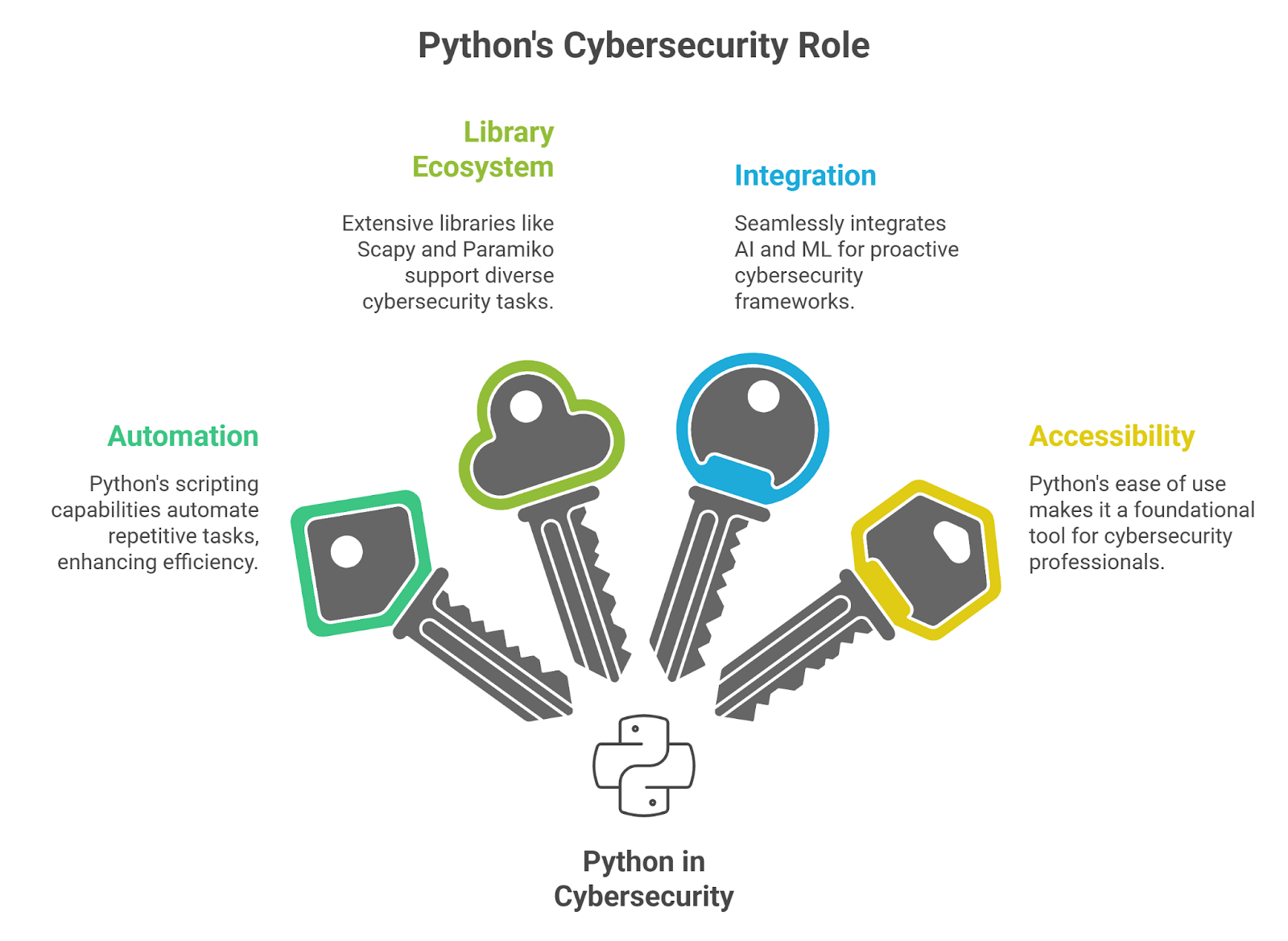
For cybersecurity experts, the most powerful tool they have in their toolkits is Python. It has clean syntax and a vast library ecosystem. Besides, it also supports scripting.
All this makes it perfect for automating repetitive tasks. Thus, Python can greatly help in the chief tasks of cybersecurity, like malware analysis, network scanning, and penetration testing.
Developers can use libraries such as Scapy, Paramiko, and PyCrypto to build robust applications that can simulate attacks. Above all, Python’s ease of integration allows you to combine AI and ML capabilities seamlessly. This is an essential requirement for proactive cybersecurity frameworks.
Hence, amateur enthusiasts and experienced professionals who take an online cybersecurity course begin with Python as their foundation.
What is Artificial Intelligence in Cybersecurity?
AI in cybersecurity uses Machine Learning and other technologies to detect and respond to cyber threats. It's like having a super smart security system that learns and adapts to new threats.
Some of its key applications include:
- Threat detection: AI can analyze network traffic and system logs to identify potential threats.
- Incident response: AI can help automate response processes. For instance, it can isolate affected systems or block malicious traffic.
- Predictive analytics: AI can predict potential attacks based on patterns and anomalies.
- Vulnerability management: AI can help identify and prioritize vulnerabilities for patching.
So, Artificial Intelligence is a game-changer for Cybersecurity. Although human oversight and expertise are still essential.
What is Machine Learning in Cybersecurity?
Machine learning in cybersecurity uses algorithms to analyze data and to identify patterns. It detects anomalies to predict and prevent cyber threats. It is like having a smart system that learns from experience to stay ahead of hackers.
Some of its key applications include:
- Anomaly detection: ML can identify unusual behavior that might indicate a threat.
- Predictive analytics: It can forecast potential attacks based on historical data.
- Threat classification: It helps in categorizing threats and thus in prioritizing responses.
- Incident response automation: With ML, it becomes possible to automate responses to common threats.
So, machine learning enhances cybersecurity by:
- Improving detection accuracy
- Reducing false positives
- Adapting to new threats
- Enhancing incident response
Thus, we see that AI and Machine Learning in Cybersecurity are related and often overlap. AI is the broader field that encompasses Machine learning and other techniques to mimic human intelligence.
Machine learning is a subset of AI that particularly focuses on training algorithms. It learns from data to offer better performance.
How AI and ML are Shifting Cybersecurity from Reactive to Predictive?
Traditional cybersecurity relies heavily on rule-based approaches. It just waits for known threats to appear before responding. AI and ML are changing this paradigm completely.
ML models now analyze huge datasets of network traffic, login histories, and behavior patterns. This helps in recognizing anomalies long before a human analyst would detect them.
Thus, a well-trained AI system can:
- Detect phishing attempts or malware signatures dynamically.
- Analyze logs to identify unusual access behavior.
- Predict potential data breaches based on evolving threat patterns.
For instance, by using Python libraries such as TensorFlow, Scikit-learn, and PyTorch, developers can train neural networks that continuously learn from new cybersecurity incidents.
Over time, this creates self-improving systems. With these systems, it becomes possible to predict and neutralize attacks autonomously.
Real-World Applications of AI-Powered Python Tools
Several cybersecurity organizations are already using AI models built in Python for strengthening defense mechanisms. Some of the examples include:
- Intrusion detection: Python-based ML models monitor real-time network data. If they detect any irregular activity, they raise alerts.
- Ransomware detection: By analyzing file behavior, AI systems can stop malicious encryption processes. This prevents system damage.
- Identity verification: Deep learning models validate user patterns across devices. This way, these can prevent credential theft.
These examples show that Python is much more than a coding language. It acts as the glue that connects data intelligence with cyber resilience.
Organizations understand it well and are rapidly adopting AI-driven cybersecurity systems. As a result, recent industry trends show that cybersecurity salary levels are higher for professionals skilled in Python and ML.
Final Words
The combination of AI expertise, Python proficiency, and cybersecurity knowledge is becoming a rare but highly valued skill set.
Clearly, we can see that when AI and cybersecurity converge, the demand for skilled professionals increases. Modern security analysts are expected to understand data modeling as well as network protocols.
This makes Python literacy indispensable, whether you work in AI-driven threat analysis or automated security infrastructure.
So, if you master both fields, you can unlock some of the most rewarding career paths in tech.